
Pallet Shuttle Storage Planned Around Your Operation
Pallet runner systems use a powered shuttle to move pallets within storage lanes. Two3 Solutions helps evaluate whether this approach fits your inventory and workflow, then coordinates layout planning, equipment sourcing and installation. Based in Wisconsin, we complete warehouse projects nationwide.
When Is Pallet Shuttle Storage a Good Fit?
Deep-lane shuttle storage is worth evaluating when you hold multiple pallets per SKU and can assign lanes around that stock profile. The decision depends on usable lane occupancy, receiving and shipping peaks, replenishment patterns and how much direct access is needed to individual pallets.
A large number of SKUs with only a few pallets each can leave partially filled lanes. The layout also needs room for forklift handoffs, shuttle transfers, battery charging and maintenance. Compare those requirements and the controls investment against the storage capacity the operation can actually use.
Video: Pallet Runner product overview
The manufacturer video below introduces the Pallet Runner shuttle and deep-lane storage concept. Manufacturer benefit statements are not a forecast for your facility; equipment quantities and expected handling performance need an application-specific review.
What Determines the Layout and System Selection?
A useful evaluation starts with the inventory and the movement of pallets through the building. Share the following information:
- Pallets stored per SKU, stock levels and seasonal changes
- Pallet dimensions, loaded heights, weights, construction and condition
- Receiving and shipping rates, including peak pallets per hour or shift
- Inventory rotation, lot separation and access requirements
- Building drawings, columns, clear height, aisles and operating environment
- Existing forklifts, lift capacity at height and pallet-handling requirements
- Required controls, system interfaces, charging arrangements and service access
Lane depth, shuttle quantity and transfer arrangements must be checked against those inputs. Ambient, chilled and freezer applications require the appropriate equipment configuration and charging provisions. Existing rack should not be assumed compatible without a system review.
How Does Two3 Plan and Implement the System?
Imagine: define the storage problem
Review the inventory, building, access requirements and the receiving-to-shipping workflow. Compare deep-lane storage with the alternatives before settling on equipment.
Integrate: coordinate the system
Work through the rack layout, pallet and forklift compatibility, shuttle selection and required interfaces with the equipment partners. Confirm responsibilities for controls, training, service and any integration included in the scope.
Implement: coordinate the installation
Plan sourcing, delivery and installation around site access and operating constraints. Required design reviews, commissioning activities and handoff responsibilities should be established for the selected system.
How Does Pallet Runner 4D Differ from a Lane Shuttle?
Automha's Pallet Runner 4D is a separate architecture from a forklift-served lane shuttle. The manufacturer describes a shuttle that can travel along and across the storage system, move between aisles and enter storage lanes, with movements coordinated by its AWMS control system.
The video below is labeled Pallet Runner 4D and illustrates that manufacturer's system. Cross-lane travel, level transfers, pallet interfaces and software integration must be specified for the proposed configuration. They are not capabilities to assume for a conventional lane shuttle.
Compare Other Pallet Storage Options
Choose the storage method around stock profile, rotation and access, rather than treating every high-density system as interchangeable.
Selective pallet racking
Consider direct access to individual pallet positions when the SKU mix and picking needs favor selectivity. Explore pallet racking design and installation.
Pallet flow
Consider gravity-fed lanes with separate loading and picking faces when first-in, first-out rotation is central to the application. Explore pallet flow racking.
Pushback racking
Consider same-aisle loading and unloading when several pallets per SKU can be stored using last-in, first-out rotation. Explore pushback racking.
Broader warehouse automation
If the requirement extends beyond storage-lane movement, review the complete material flow. Explore warehouse automation planning to assess the related handling and integration needs.
Related Storage Systems

Autostore
Bin-based goods-to-person storage for smaller items. A different application from full-pallet shuttle storage.
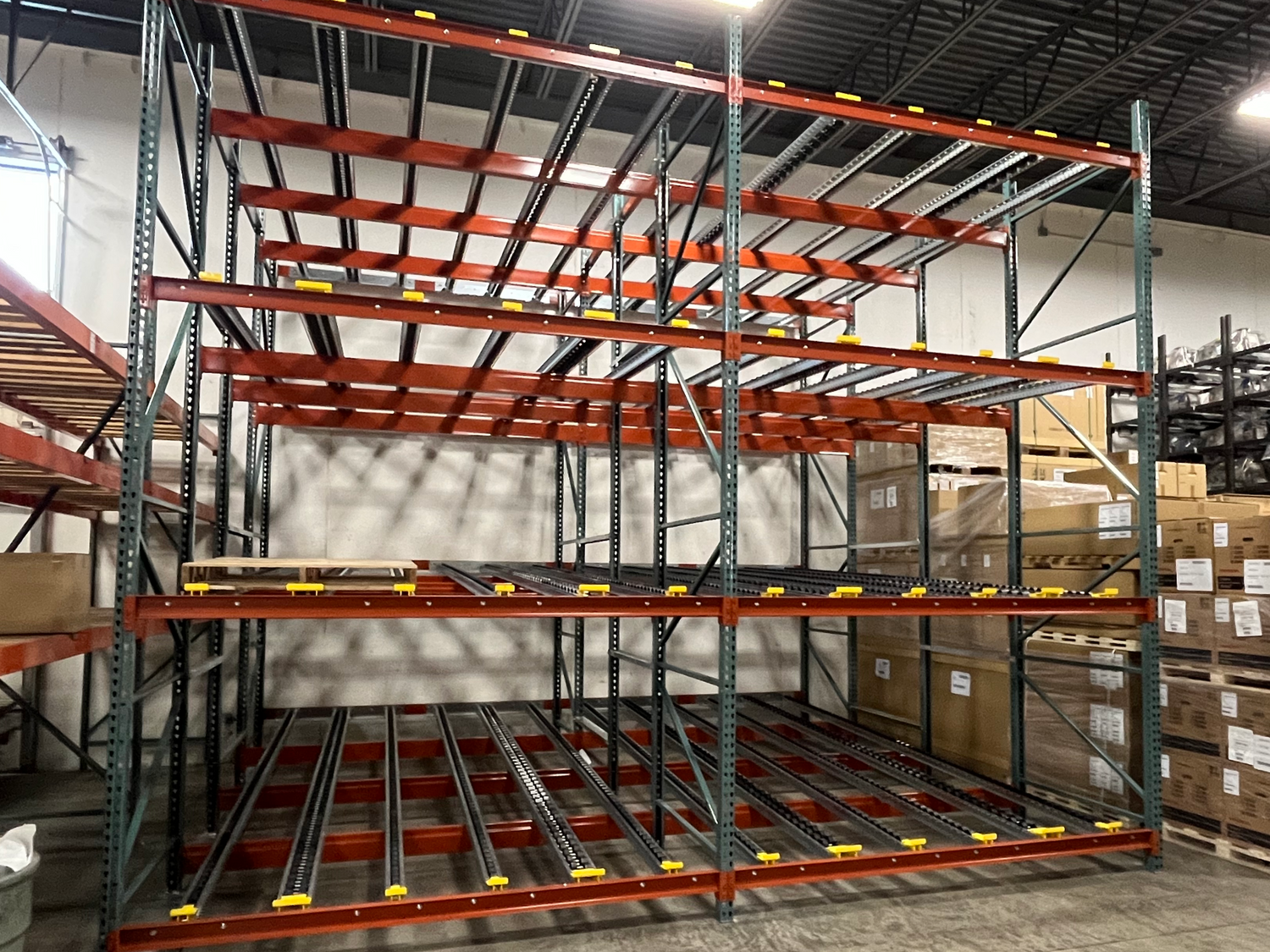
Pushback racking
Same-aisle, last-in, first-out pallet storage. Compare lane depth and inventory rotation.

Drive-in racking
High-density pallet storage in which lift trucks enter rack lanes. Access and handling requirements differ.